IS COUCH TO 5K TOO HARD?
Start from where you are — not where a generic plan says Runnify
Couch to 5K doesn’t have to feel too difficult.
Get a running plan adapted to your current fitness, experience and schedule — with a progression that works for you.
Millions of people have started running thanks to Couch to 5K program.
But what if the problem isn’t your motivation…
What if the plan simply isn’t designed for your starting point?
If you’ve ever felt that Couch to 5K progressed too quickly—or if you’ve already quit once—this guide will show you why that happens and what you can do differently.
You downloaded a Couch to 5K plan.
You were excited.
You bought a pair of running shoes.
You completed the first workout and thought:
“Maybe I really can do this.”
Then something changed.
Week after week, the running intervals became longer.
The recovery periods became shorter.
Your legs felt heavier.
Your breathing became harder.
Instead of feeling stronger, you started wondering whether running simply wasn’t for you.
If this sounds familiar, you’re far from alone.
Every year, thousands of beginner runners search Google for things like:
- Couch to 5K too hard
- I can’t finish Couch to 5K
- Alternative to Couch to 5K
- Easier Couch to 5K plan
The good news?
It doesn’t necessarily mean you’re out of shape.
It doesn’t mean you’re lazy.
And it certainly doesn’t mean you can’t become a runner.
In many cases, it simply means you’re following a fixed training plan that wasn’t designed specifically for you.
Because here’s the reality:
Two beginners rarely start from the same place.
One person might already walk every day.
Another might have spent years exercising in the gym.
Someone else may be returning after pregnancy.
Another runner may be carrying extra weight.
A 25-year-old and a 60-year-old won’t recover at the same speed.
Yet many beginner running plans ask every one of those people to follow exactly the same progression.
That’s where problems begin.
In this guide, we’ll explain:
- Why some beginners struggle with traditional Couch to 5K plans
- Why a single fixed progression doesn’t work for everyone
- What makes a more personalized approach easier to stick with
- How Runnify adapts your training to your fitness level and progress
Our goal isn’t to convince you that Couch to 5K is a bad program.
Far from it.
It has introduced millions of people to running over the past three decades.
Instead, we’ll show you why personalization is becoming the next evolution of beginner running plans.
Why Couch to 5K Became So Popular
Before discussing alternatives, it’s important to understand why Couch to 5K became one of the most successful beginner running programs ever created.
When it first appeared, its biggest innovation wasn’t the 5K goal.
It was the idea of combining walking and running intervals.
Instead of asking complete beginners to run continuously for 20 or 30 minutes, it broke every workout into manageable intervals that gradually increased over time.
This simple concept transformed running from something intimidating into something achievable.
For millions of people, it worked.
It gave beginners:
- A clear goal
- A structured weekly schedule
- Small, measurable progress
- Enough recovery to build confidence
Even today, many runners complete their very first 5K thanks to Couch to 5K.
And for that reason alone, it deserves enormous credit.
But popularity doesn’t necessarily mean one version of the program is perfect for everyone.
Because while the philosophy is excellent…
every beginner is different.
The Problem Isn’t Couch to 5K
This is where many articles get it wrong.
You’ll often read headlines claiming that Couch to 5K is “too hard.”
We don’t believe that’s entirely true.
The real issue is much simpler.
A fixed plan assumes that every beginner adapts at roughly the same speed.
Real life doesn’t work that way.
Some runners recover quickly.
Others need a few extra days.
Some can comfortably progress every week.
Others might need to repeat a week before moving forward.
Neither approach is right or wrong.
They’re simply different.
Imagine giving exactly the same training plan to:
- A 22-year-old university student who already plays football twice a week.
- A 45-year-old office worker who’s been inactive for years.
- Someone recovering from a minor injury.
- A parent trying to fit workouts around family life.
Should all four people follow exactly the same weekly progression?
Probably not.
Yet that’s exactly what most printable beginner plans ask you to do.
That’s why many runners don’t fail because they’re incapable of running.
They fail because the progression doesn’t match their current fitness level.
Every Runner Progresses at a Different Pace
One of the biggest mistakes beginner runners make is comparing themselves to other people.
Your friend might comfortably move from Week 3 to Week 4.
You might need another week before your breathing feels under control.
Someone else might progress even faster.
That’s completely normal.
Running improvements depend on many different factors, including:
- Your current fitness level
- Previous sports experience
- Age
- Body weight
- Recovery ability
- Sleep
- Stress
- Consistency
These variables influence how quickly your muscles, tendons, bones and cardiovascular system adapt to running.
A training plan can’t change your biology.
But it can respect it.
That’s why we believe beginner plans should adapt to runners—not the other way around.
IS COUCH TO 5K TOO HARD?
Start from where you are — not where a generic plan says Runnify
Couch to 5K doesn’t have to feel too difficult.
Get a running plan adapted to your current fitness, experience and schedule — with a progression that works for you.
Why Fixed Progressions Don’t Work for Every Beginner
Most beginner running plans follow the same principle:
Complete this week.
Move to the next one.
Repeat until you can run 5K.
It sounds simple.
But there’s one major problem.
Your body doesn’t know what week you’re on.
It doesn’t know the calendar says it’s Week 5.
It only knows how much stress it’s been exposed to—and whether it has had enough time to adapt.
Some runners are ready for the next step after a few days.
Others need another week before they feel comfortable.
Neither is failing.
They’re simply adapting at different speeds.
That’s why expecting every beginner to follow exactly the same progression often creates unnecessary frustration.
A training plan should guide your progress.
It shouldn’t dictate it.
The Three Biggest Limitations of Traditional Couch to 5K Plans
The original Couch to 5K philosophy is excellent.
Gradually increasing your running volume is one of the safest ways to become a runner.
However, many traditional Couch to 5K plans share three important limitations.
1. One Progression for Everyone
Most printable plans assume that every runner is ready to move forward after completing each week.
But that’s rarely true.
Some beginners adapt very quickly.
Others need to repeat workouts before feeling comfortable.
A fixed PDF can’t tell the difference.
It simply tells everyone to move on.
That doesn’t mean the plan is wrong.
It simply means it’s not personalized.
2. Running Isn’t the Only Thing That Matters
Running places stress on your muscles, tendons, bones and joints.
Especially when you’re completely new to the sport.
That’s why experienced coaches rarely recommend running alone.
Simple strength exercises improve stability.
Mobility helps maintain good movement.
Together, they can reduce injury risk while making running feel easier over time.
Unfortunately, most printable Couch to 5K plans stop at running and walking intervals.
The rest is left up to you.
3. Real Life Doesn’t Follow a Perfect Schedule
Life happens.
You get sick.
You travel.
You miss a workout.
You go on holiday.
You have a stressful week at work.
A printed plan can’t respond to any of those situations.
It assumes every workout happens exactly as planned.
Real runners know that’s rarely the case.
Progress Isn’t Linear
One of the biggest misconceptions in beginner running is that improvement should happen in a straight line.
Week after week.
Workout after workout.
In reality, progress looks much more like this:
✔ A great week.
✔ A difficult week.
✔ A breakthrough.
✔ A setback.
✔ Another breakthrough.
Your fitness is constantly adapting.
Some weeks you’ll surprise yourself.
Other weeks your legs will feel unusually heavy.
That’s completely normal.
The goal isn’t to follow a calendar perfectly.
The goal is to keep moving forward consistently.
A More Gradual Progression Can Make a Huge Difference
One of the easiest ways to make beginner running more enjoyable is simply to slow down the progression.
Not the running pace.
The progression itself.
Giving your body a little more time to adapt often means:
- Greater confidence
- Better consistency
- Less frustration
- Lower injury risk
- A much higher chance of completing your first 5K
For many beginners, the difference between success and quitting isn’t motivation.
It’s having enough time to adapt.
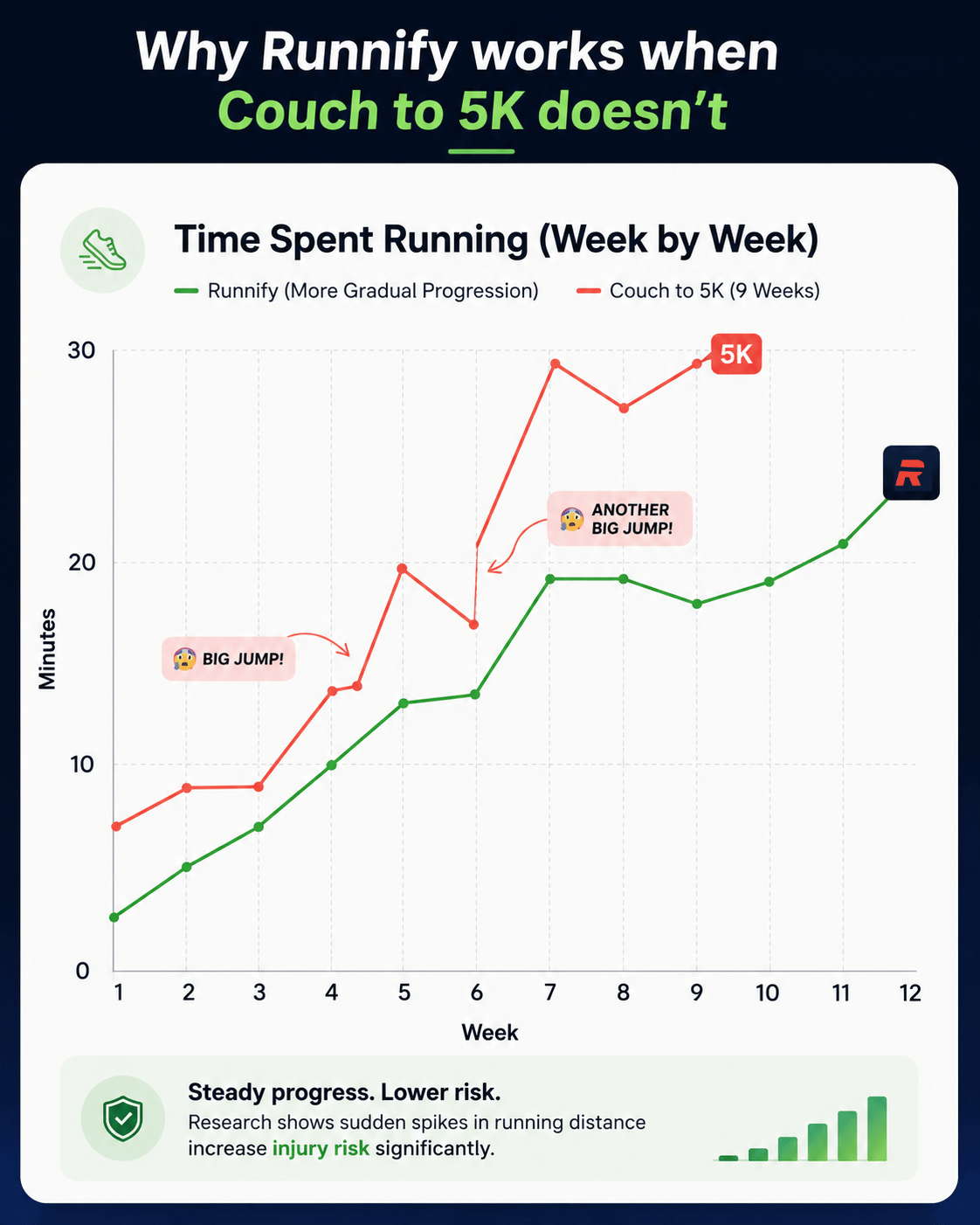
Traditional vs Progressive Couch to 5K Progression
A fixed beginner plan assumes everyone adapts at the same speed.
A more gradual progression gives your body more time to recover, build fitness and stay consistent—making it easier to reach your first 5K with confidence.
Meet Runnify: A Beginner Plan That Adapts to You
Instead of asking every runner to follow exactly the same progression, Runnify was built around a simple idea:
Your training should adapt to you—not the other way around.
That’s why Runnify doesn’t lock every beginner into a single 9-week schedule.
Instead, you can choose the progression that best matches your starting point and goals.
Whether you’re completely new to running, returning after a long break or simply prefer a slower build-up, the plan adapts to your needs.
Because completing your first 5K isn’t about doing it as quickly as possible.
It’s about building a running habit that lasts.
What Makes Runnify Different?
Rather than simply replacing one fixed Couch to 5K plan with another, Runnify offers a more personalized training experience.
Choose the progression that suits you
Some runners are ready for a faster progression.
Others benefit from a more gradual approach.
With Runnify, you decide.
Train with guided audio
There’s no need to keep checking your watch.
Guided audio tells you exactly when to run, walk and recover, so you can focus on enjoying the workout.
Strength and mobility included
Running is only part of becoming a runner.
Runnify also includes simple strength and mobility sessions designed to help you build resilience and reduce injury risk.
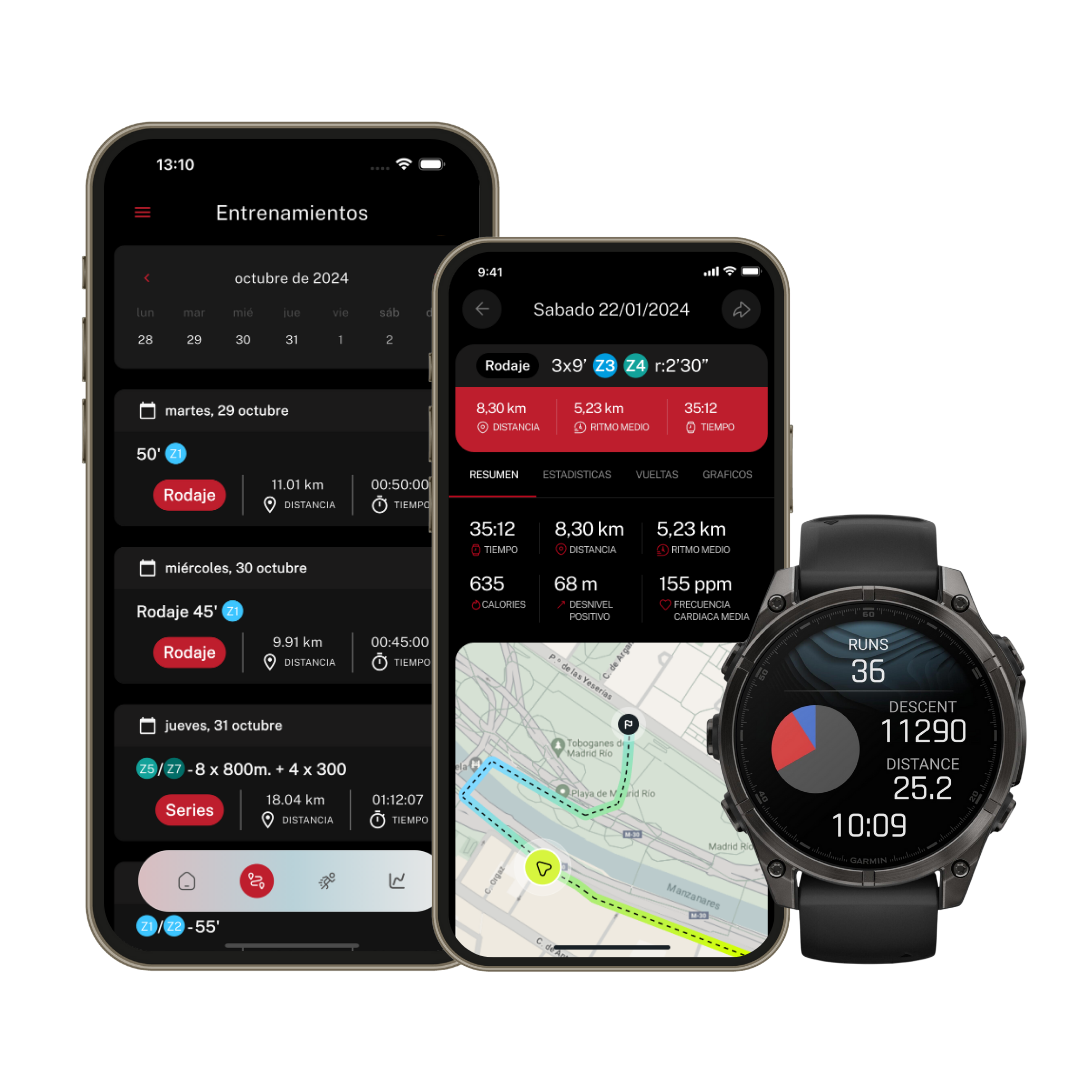
Automatic progress tracking
Your completed workouts are recorded automatically, helping you stay motivated as your fitness improves.
Sync with your sports watch
Prefer training from your wrist?
Runnify syncs your workouts with Garmin, Apple Watch, COROS, Polar, Suunto and other compatible devices.
| Traditional Couch to 5K | Runnify Couch to 5K Plan |
|---|---|
| Fixed progression | More gradual progression |
| Run and walk only | Includes strength & mobility in the app |
| Everyone follows the same pace | Adapts to the runner |
| Designed almost 30 years ago | Based on modern training |
Is a More Gradual Running Plan Right for You?
A more personalized approach isn’t just for people who find Couch to 5K difficult.
It’s for anyone who wants to build a lasting running habit without feeling pressured to keep up with a fixed schedule.
You might benefit from a more gradual progression if…
You’re Starting from Zero
If you’ve never run before, even one minute of continuous running can feel like a huge challenge.
That’s perfectly normal.
Your cardiovascular system, muscles, tendons and joints are all adapting to a completely new activity.
Starting with a progression that matches your current fitness level can make those first few weeks feel much more achievable.
You’ve Tried Couch to 5K Before
Many runners don’t complete Couch to 5K the first time.
That doesn’t mean you failed.
It simply means the progression wasn’t the right fit for you at that moment.
A more flexible approach allows you to progress at your own pace instead of trying to keep up with a predefined calendar.
You’re Returning After an Injury
Coming back from an injury is very different from starting as a complete beginner.
You may still have good cardiovascular fitness while your muscles or tendons need more time to adapt.
Choosing a more conservative progression helps rebuild confidence while reducing unnecessary stress.
You’re Over 40
As we get older, recovery naturally takes a little longer.
That doesn’t mean you can’t become a runner.
It simply means your training should respect your recovery.
Many runners in their 40s, 50s and beyond successfully complete their first 5K every year.
The key is progressing at a pace your body can sustain.
You’re Running to Lose Weight
If weight loss is one of your main goals, consistency is far more important than intensity.
Running too hard too soon often leads to soreness, missed workouts and frustration.
A gradual progression helps you stay active week after week while steadily improving your fitness.
What If the Plan Feels Too Easy?
This is one of the most common questions beginners ask.
The answer might surprise you.
If a workout feels easy…
that’s usually a good thing.
Beginner plans aren’t supposed to leave you exhausted after every session.
They’re designed to help your body adapt gradually.
Many new runners make the mistake of speeding up every run simply because they feel comfortable.
Instead, focus on consistency.
If you consistently feel ready for more, Runnify allows you to choose a faster progression that better matches your current fitness.
What If the Plan Feels Too Hard?
This is where many runners give up.
But they shouldn’t.
A difficult workout doesn’t mean you’re not capable of becoming a runner.
It simply means your body needs a little more time.
Instead of forcing yourself to push through every session, consider slowing the progression.
Repeating a workout or choosing a more gradual plan isn’t taking a step backwards.
It’s giving yourself the best chance of moving forwards.
Running isn’t a race against the calendar.
It’s a process of adapting over time.
How Long Should It Take to Run Your First 5K?
One of the biggest myths in beginner running is that everyone should reach 5K within the same number of weeks.
In reality…
there’s no perfect timeline.
Some runners complete their first 5K after nine weeks.
Others need twelve.
Some take sixteen weeks.
All of them are runners.
Remember:
The finish line doesn’t care how many weeks it took you to get there.
What matters is building a habit that lasts long after your first 5K.
Signs You’re Following the Right Beginner Plan
A good beginner running plan should challenge you…
without overwhelming you.
Here are a few signs you’re on the right track:
✅ You finish most workouts feeling like you could do a little more.
✅ Your confidence increases week after week.
✅ You’re staying consistent.
✅ You’re recovering well between sessions.
✅ You’re looking forward to your next run.
If every workout leaves you exhausted, discouraged or in pain, the progression may simply be moving faster than your body is ready for.
Why Building the Habit Matters More Than Running 5K
Many beginners become obsessed with one number.
5 kilometers.
But experienced runners know something different.
The first 5K isn’t the finish line.
It’s the beginning.
The real goal isn’t completing one run.
The real goal is becoming someone who enjoys running regularly.
Because once running becomes a habit…
Improving your pace becomes easier.
Running further becomes easier.
Losing weight becomes easier.
Preparing for a 10K becomes easier.
Everything starts with consistency.
And consistency comes from following a plan you can actually stick to.
A Personalized Plan Gives You the Best Chance of Success
No training plan can guarantee success.
But the closer your training matches your current fitness level, the more likely you are to stay consistent.
That’s the philosophy behind Runnify.
Instead of asking you to adapt to a fixed calendar…
Runnify adapts the training progression to you.
Because every runner deserves a plan that feels challenging…
without feeling impossible.
Ready to Start Running at Your Own Pace?
Whether you’re starting from zero, returning after a long break or looking for a more gradual alternative to traditional Couch to 5K plans, Runnify helps you progress at a pace that matches your fitness level.
With personalized progressions, guided audio workouts, strength training, mobility sessions and automatic progress tracking, you’ll have everything you need to complete your first 5K with confidence.
IS COUCH TO 5K TOO HARD?
Start from where you are — not where a generic plan says Runnify
Couch to 5K doesn’t have to feel too difficult.
Get a running plan adapted to your current fitness, experience and schedule — with a progression that works for you.