Heart Rate Zone Calculator
Calculate your personalised heart rate training zones using the Karvonen formula, % Max HR or Zoladz method. Runnify uses an 8-zone model based on % of max heart rate — from active recovery to lactic power — so every session has a clear purpose. Start your plan in Runnify to automatically get your heart rate, pace and RPE zones tailored to your level — combining these three metrics is the most accurate way to control training intensity.
Your heart rate training zones
| Zone | Heart rate | % max HR | % VAM pace | RPE | Purpose |
|---|
See how your zones differ across calculation methods.
| Zone | Karvonen | % Max HR | Zoladz |
|---|
Get your zones automatically with Runnify
Complete the VAM test included in Runnify and get heart rate, pace and RPE zones personalised to your fitness — updated as you improve.
Heart rate zone training guide
How Runnify's 8-zone model works and frequently asked questions
What are heart rate training zones?
Heart rate training zones are ranges of heart rates that correspond to different exercise intensities. Each zone targets specific physiological adaptations — from fat burning and aerobic base building to lactate threshold and maximal oxygen uptake.
Runnify uses an 8-zone system based on your VAM (maximal aerobic speed) test. This calculator estimates heart rate ranges from % of max HR; in the app, pace and heart rate targets are calculated automatically and updated as you improve.
How the Karvonen formula works
The Karvonen formula (Heart Rate Reserve method) accounts for your resting heart rate — something simpler methods ignore. A fitter runner with a lower RHR gets different, more appropriate zone boundaries.
Target HR = ((Max HR − Resting HR) × %Intensity) + Resting HR
Lab testing (VO₂ max test) remains the gold standard for the most precise max heart rate and individualised zones.
Three calculation methods
Karvonen — most accurate for individuals; needs resting heart rate. % Max HR — simplest; multiplies max HR by zone percentage. Zoladz — subtracts fixed bpm values from max HR. All three use Runnify's 8-zone % max HR definitions for Karvonen and % Max HR; Zoladz uses its own bpm-band structure mapped to 8 zones.
Why use Runnify for your zones?
This calculator gives useful estimates. In the Runnify app, zones are generated automatically from a VAM field test — heart rate, pace (% VAM) and RPE ranges personalised to you. Your plan adapts as fitness improves, so easy days stay easy and hard sessions hit the right intensity.
How to use your zones
- Z1–Z2 (70–84% max HR) — 70–80% of weekly volume. Build aerobic base without excessive fatigue.
- Z3 (85–89%) — Steady endurance and controlled long runs.
- Z4 (92%) — Tempo and threshold development.
- Z5 (96%) — Supra-threshold work for 5K–10K performance.
- Z6 (100%) — VO₂ max intervals of 3–5 minutes.
- Z7–Z8 — Pace-based zones for short reps, strides and sprints.
Get your zones automatically with Runnify
Complete the VAM test included in Runnify and get heart rate, pace and RPE zones personalised to your fitness — updated as you improve.
Frequently asked questions
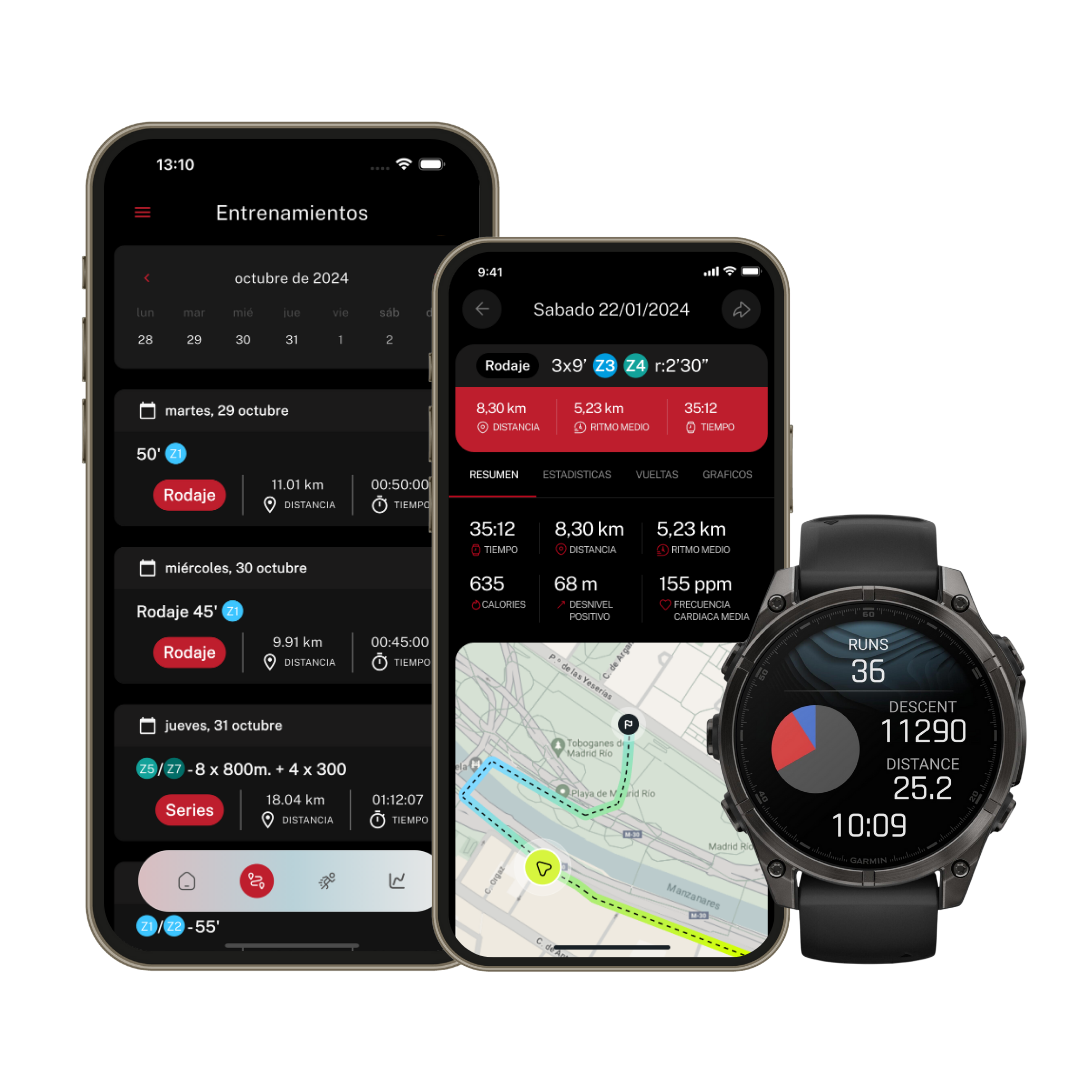
Take your running to the next level
Your personalized running coach with tailored training plans to achieve your goals, from running your first 5K to completing your first marathon.


7 days free. Cancel anytime.