TRAINING WITH THE RIGHT ZONES?
Turn your training zones into a plan built for you Runnify
Knowing your zones is useful. Knowing how to train with them is even better.
Get a running plan adapted to your fitness, experience, schedule and goals — with workouts designed to help you train at the right intensity.
If there’s one mistake I constantly see recreational runners make, it’s this:
They train at the same intensity all the time.
One day they go out for a run and push hard.
The next day they run again… and push hard.
And when race day comes, they try to go even harder.
The result is usually the same:
- Performance plateaus
- Constant fatigue
- Injuries
- Frustration from not improving personal bests
However, runners who consistently improve use a fundamental tool: training zones.
Understanding and applying running training zones correctly can completely transform your performance.
In this article, you’ll learn:
- What training zones really are
- Why they’re so important for improving your running
- How to use them in your training plan
- Whether you should train by pace, heart rate, or effort
- The most common mistakes runners make
And most importantly, how training zones can help you achieve your next personal best.
What are Training Zones?
Training zones are physiological intensity ranges used to structure endurance training.
Each zone places a different demand on the body, including:
- Aerobic energy production
- Energy metabolism
- Lactate production and clearance
- Muscular fatigue
Put simply:
Each training zone creates a different adaptation in your body.
That’s why running at the same intensity every day eventually limits your progress.
Why Training Zones improve running performance
Modern endurance training is built on a fundamental principle:
Every workout should have a specific physiological objective.
When you train using running zones, you can:
Control Training Intensity More Accurately
Many runners think they’re running easy when they’re actually running too hard.
Training zones help you apply the right stimulus at the right time.
Optimize Physiological Adaptations
Different zones target different adaptations:
- Increased mitochondrial density
- Improved oxygen delivery
- Higher VO₂ max
- Better lactate threshold
These are the adaptations that ultimately make you a faster runner.
Reduce Injury Risk
One of the biggest mistakes recreational runners make is training too hard too often.
Managing intensity correctly helps:
- Reduce physiological stress
- Improve recovery
- Prevent overuse injuries
TRAINING WITH THE RIGHT ZONES?
Turn your training zones into a plan built for you Runnify
Knowing your zones is useful. Knowing how to train with them is even better.
Get a running plan adapted to your fitness, experience, schedule and goals — with workouts designed to help you train at the right intensity.
Should you train by Pace, Heart Rate, or Effort?
Many runners believe that training zones can only be used through heart rate training.
In reality, there are three primary ways to control running intensity.
Training by Pace
Running by pace means maintaining a specific speed.
For example:
- 6:00 min/km
- 5:00 min/km
- 4:00 min/km
Pace-based training is especially useful for:
- Intervals
- Track workouts
- Fartlek sessions
- Race-specific training
However, pace has an important limitation.
It doesn’t account for factors such as:
- Heat
- Humidity
- Wind
- Fatigue
- Hills
That’s why the same pace can feel completely different from one day to another.
Training by Heart Rate
Heart rate training allows you to understand how your body responds to exercise.
Heart rate zones for runners can be particularly useful for:
- Easy runs
- Aerobic development
- Recovery monitoring
However, heart rate also has limitations.
Your heart rate can be influenced by:
- Stress
- Lack of sleep
- Dehydration
- Illness
- Caffeine
- Hot weather
In addition, many runners rely on automatically generated heart rate zones from their watches, which often do not accurately reflect their true physiological thresholds.
Training by Perceived Effort (RPE)
Rate of Perceived Exertion (RPE) is a method of measuring how hard a workout feels.
Although it may seem less scientific, many coaches and elite athletes consider RPE running one of the most reliable ways to regulate training intensity.
The reason is simple:
Your body often detects fatigue before your watch does.
Learning to recognize effort levels allows you to adjust training based on how you actually feel in real time.
The Runnify Approach
At Runnify, we combine all three methods.
We use:
- Pace to prescribe specific workout targets
- Heart rate to validate physiological response
- Perceived effort as the primary guide
Because no single metric tells the whole story.
Our goal is to help runners understand their bodies while using technology as a tool—not as a limitation.
Running Training Zones
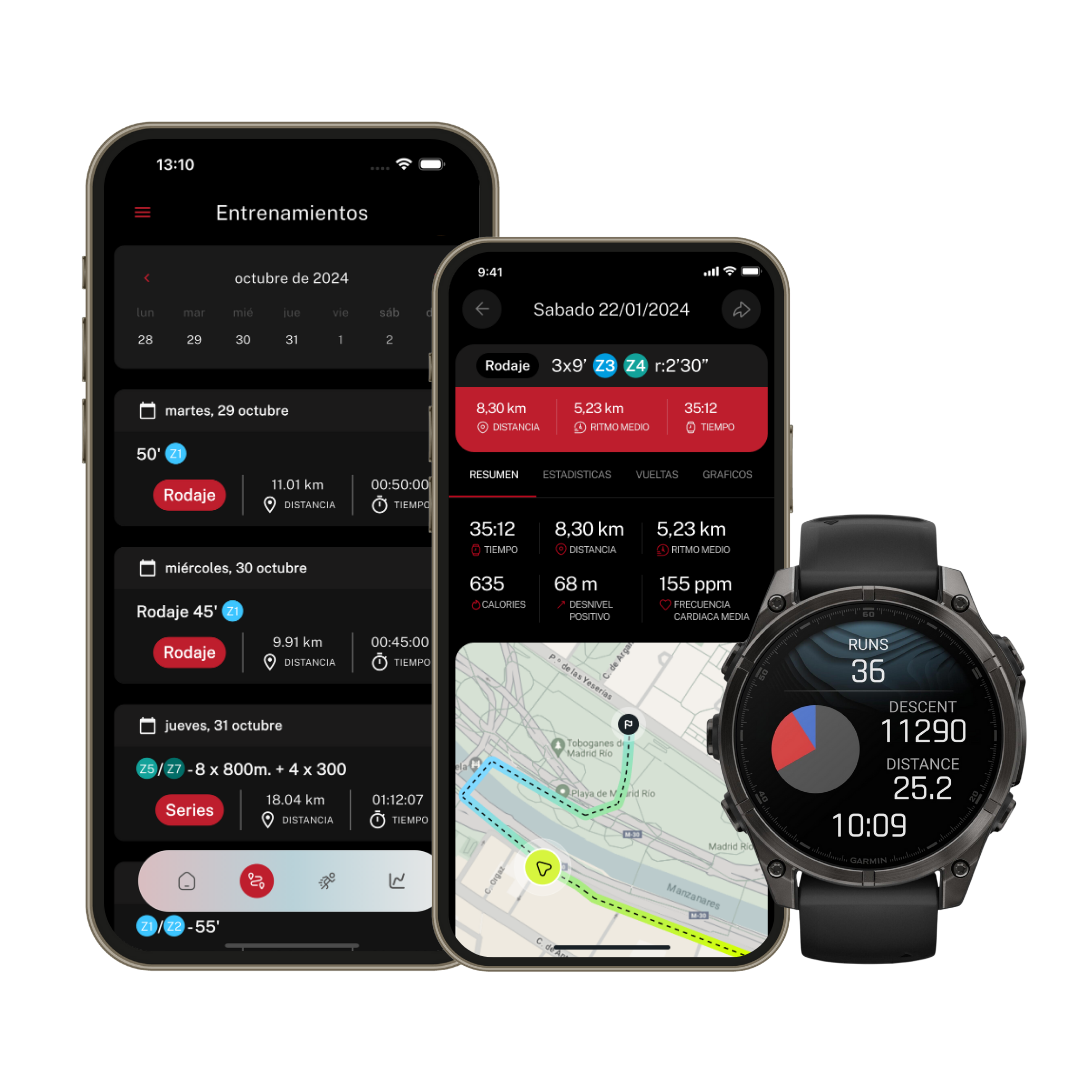
At Runnify, we use an 8-zone training system that allows us to precisely control the physiological stimulus of each workout.
Each zone has a specific purpose and is used at different stages of a training plan.
Runnify Training Zones
Our 8-zone system is based on your VAM (maximal aerobic speed) test. Pace and heart rate ranges are personalized for you in the app.
| Zone | Name | % VAM pace | % max HR | RPE | Purpose |
|---|---|---|---|---|---|
| Z1 | Active recovery | 50-55% | 70-78% | 2 | Recovery runs, warm-up and cool-down |
| Z2 | Aerobic threshold | 60-65% | 80-84% | 3-4 | Easy runs, aerobic base building (most of your volume) |
| Z3 | Between thresholds | 70-75% | 85-89% | 5-6 | Steady endurance, long runs with controlled effort |
| Z4 | Tempo / threshold | 80-85% | 92% | 7 | Tempo runs, lactate threshold development |
| Z5 | Supra Umbral (>UAN) | 90-95% | 96% | 8-9 | Metabolic instability zone, indicated for improving performance in short distances, like 5K |
| Z6 | VO₂ max | 100% | 100% | 10 | Short–medium intervals (3–5 min), aerobic power |
| Z7 | Anaerobic capacity | 105-110% | - | - | Short reps (1–2 min), speed endurance |
| Z8 | Lactic power | 115-120% | - | - | Strides, sprints and maximal efforts (< 1 min) |
Exact pace and heart rate targets are calculated automatically in Runnify after your fitness test and updated as you improve.
You can calculate your training zones with our heart rate training zone calculator.
How to Apply Training Zones to Your Running Plan
A common misconception is that training harder always leads to faster improvement.
The reality is very different.
Most runners should distribute their training approximately as follows:
- 70-80% of training volume in lower zones (Z1-Z2)
- 15-20% in moderate zones (Z3-Z4)
- 5-10% in higher zones (Z5-Z8)
This approach helps:
- Improve performance
- Prevent overtraining
- Promote long-term progress
- Maintain consistency for months and years
Why can’t I stay in Zone 2?
One of the most common questions about zone 2 running is:
“Why does my watch say I’m out of Zone 2 even when I’m running slowly?”
Several factors can explain this:
- Incorrect zone settings
- Inaccurate maximum heart rate estimates
- Limited aerobic fitness
- Stress and accumulated fatigue
- Hot weather conditions
In some cases, especially for beginners, staying strictly in Zone 2 may require alternating between running and walking.
This is completely normal.
As your aerobic fitness improves, you’ll be able to run faster while maintaining the same heart rate.
That’s why it’s important not to become obsessed with a single metric and instead understand the bigger picture of training.
Common Training Zone Mistakes
Training hard every day
The number one mistake.
Many runners turn every workout into a race.
Not knowing your real zones
If you don’t know your actual training zones, it’s impossible to manage intensity effectively.
That’s why regular performance testing is so important.
Becoming obsessed with your watch
Technology is a fantastic tool, but it should never replace your own sensations.
Ignoring perceived effort
Learning to listen to your body remains one of the most important skills any runner can develop.
The importance of assessing your performance
There is a well-known phrase in endurance training:
“To train is to evaluate, and to evaluate is to train”.
That’s why regular testing is essential for updating your training zones and optimizing your training plan.
Your zones evolve as your fitness improves.
What feels like a high-intensity effort today may become a moderate effort a few months from now.
This is exactly what we do at Runnify.
Take Your Running to the Next Level
If you want to improve your running performance, learning how to manage training intensity is essential.
At Runnify, we’ve built a platform that helps you:
- Automatically calculate your training zones
- Follow structured training plans
- Monitor your progress
- Adapt each workout to your current fitness level
Everything is based on exercise physiology and modern training science.
Download Runnify today and start training smarter.
TRAINING WITH THE RIGHT ZONES?
Turn your training zones into a plan built for you Runnify
Knowing your zones is useful. Knowing how to train with them is even better.
Get a running plan adapted to your fitness, experience, schedule and goals — with workouts designed to help you train at the right intensity.